


Understanding Turkeys by TR Michels
article copyright
Turkey habits vary greatly by region and even local areas. Some Eastern and Merriam’s turkeys become accustomed to human activity and inhabit cities and towns, while a few miles away the mere sight of a car will send birds into cover. In some western areas birds may frequent farmyards, use groves and buildings for roost sites; exhibit no fear of humans, dogs or livestock; and become pets.
Reaction to Danger
Wild turkeys are extremely wary, with excellent eyesight, but they don’t hear much better than the average human. However, they are very aware of suspicious noises. Their first reaction to possible danger is alarm, the sounding of the “alarm putt”, and they often fly or run away. Turkeys have better eyesight than humans but, because of their widely spaced eyes, they have poor binocular vision and depth perception; they see very little in front of them with both eyes at the same time, which makes it difficult for them to determine the relative size and distance of objects. However, movement makes them alert.
Wild turkeys are normally extremely wary, with excellent eyesight, but they don’t hear much better than humans. However, they are very aware of suspicious noises; their first reaction to possible danger is alarm, and when they are alarmed they usually sound an alarm-call and run away or take flight. However, they will not usually leave their home range. Because of the small size of their brain turkeys don’t have the ability to learn as well as animals with larger brains. With a limited ability to learn, and because they inhabit a traditional home range, fleeing turkeys usually do not leave their range but flee back into it; or if they do leave they return soon after. Because they have not been outside their home range, the risk of danger is greater outside the home range than it is in it. As a result of this, turkeys seldom vacate their home range due to hunting pressure; they may be hunted out of an area, but usually not driven out of an area. They may not even avoid places that have been dangerous to them in the past. I have shot turkeys in the same area where they were shot at and missed the day before.
Flocking Behavior
Turkeys habitually occur in flocks. Hens and the young of the year often stay together throughout the summer in family groups or flocks of several families. In the fall young males or “jakes” form their own flocks and stay together through the winter; they may join the adult males in the spring, during the breeding season. Adult male flocks form in the summer (after the breeding season) and remain together until spring, when some birds go off by themselves, but, toms may form small groups of two or more birds during the breeding season. Groups of gobblers may form an alliance and fight other groups for dominance and breeding rights.
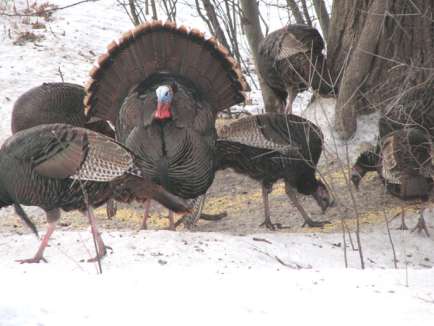
Winter
During the winter, turkeys separate into flocks of different sexes and age groups. The old and young hens remain in one flock, the young males in another, and the toms in yet other flocks. This flocking instinct is strong in most grazing animals that depend on their ability to see and hear for defense. Because they spend so much time eating they can’t always be on guard; therefore, the more animals there are together the more time each one can spend eating while others watch; there is security in numbers.
Spring
With the approach of spring the weather gets warmer, daylight hours become longer and the urge to mate comes over turkeys. The jakes join the toms and begin forming small groups that search for hens. The toms and jakes begin to associate with the hens as they all look for new spring growth (succulent grasses and forbes) and insects that appear near stream beds and on south facing slopes (that warm up first). They look for leftover agricultural crops, mast crops of nuts and acorns; and pick through cow chips, cattle feeding areas, and old and new plowing for insects and leftover food. Where turkeys inhabit hilly or mountainous terrain they may even change home ranges, seeking higher elevations as snow depth decreases and new forage becomes available. They may travel from as little as a half mile, to as many as several miles between their winter and spring range.
Breeding Activity
Gobbling is the tom’s way of expressing dominance; telling all the turkeys in the area that he is ready to breed, and to fight for the right. Toms also use gobbling as a means of attracting hens. Supposedly, the toms call to get the hens to come to them; but toms do respond to hen calling and will go to the hen. The advertising strategy of the tom changes once it is near a hen; gobbling is used to attract hens from a distance. When the tom is within visual distance of the hen it begins to strut, relying on the color of it’s head, it’s expanded tail, and it’s puffed up body size to attract the hen; to prove it is the biggest, healthiest, most colorful male. This explains the dimorphism (the difference in coloration, size, or antler growth) in many animals. The strongest, healthiest male with the most coloration or largest rack, attracts more females, breeds more females and passes on his genes to the offspring.
I don’t doubt that toms gobble to get hens to come to them. But, in my research I found that the hens were often in a feeding/strutting area first, often using the adult version of the “lost-yelp” call, then the toms showed up, gobbling as they came. Once the toms saw the hens they usually started strutting and pursuing the hens. Only then did breeding occur. I believe that in many instances, the toms respond to the calling of the hens, not the other way around.
A graph of turkey gobbling and breeding activity is much like the graph of rubbing and breeding activity in white-tailed deer. Turkeys, like deer, are influenced by photoperiod (the number of light hours per day), but it is lengthening hours of daylight, not shortening hours of daylight, and warmer spring temperatures that trigger turkey-breeding behavior.
Phase 1: Initial Gobbling Period
As the spring days become longer the toms start to gobble. The earliest gobbling is usually performed by adult males, and as the days grow longer more males gobble. The first gobbling begins about two months before the gobbling peak (during Phase 3). In the south gobbling may begin as early as February, in the north as early as late March. During this phase both the hens and toms begin establishing dominance, which may cause a lot of chasing and fighting.
While the hens may not be willing to breed at this time, the toms are. The toms usually answer the calls of the hens, but they may not go to them. Because this is when dominance is established, toms often come to the sound of a gobbler to exert dominance, or to the sound of a hen to initiate breeding.
Phase 2: Breeding Period and Gobbling Lull
As the days continue to grow longer, and the weather warms, the hens become interested in breeding, and they may spend more time near the toms. When the hens are within visual distance the toms display (strutting, showing their colorful head) and use the Spit call and sound of the Drum to keep the hens nearby; since there is more strutting there is less gobbling. This is when it’s difficult to get a tom to respond to a call, because they are usually with the hens. About a month after the toms begin to gobble most of the hens become receptive and gobbling activity is at its lowest. This phase may last from a few days to a couple of weeks, depending on the number and sex ratio of birds in the area, and the weather.
Phase 3: Post Breeding Period and Gobbling Peak
As more of the hens are bred they begin to nest, and the toms, still interested in breeding, gobble more frequently. Approximately a month after peak breeding occurs most of the hens have been bred and will be nesting. Gobbling activity reaches is highest level during this phase, while the hens nest and the toms try to attract any hens that have not been bred. This is when the toms are most willing to respond to hen calling.
Breeding Activity and Weather
Late snow and spring rain, with cold weather and cloudy days, can disrupt or delay the gobbling activity of toms, and the willingness of hens to respond to gobbling, and to breed and nest. Wet cold weather also may affect nesting success, and cause a second nesting attempt if the hen’s eggs have been destroyed or the young poults die. When this happens it may cause another decrease in gobbling activity, making it difficult to call the birds. If the weather warms up earlier than normal, the hens may begin breeding and nesting earlier than normal.
One of the best tips on turkey hunting is to know which breeding phase the turkeys are in, and then use the right calls and hunting techniques for that phase. During Phase 1 and 3, calls and decoys work well to bring toms in, because the hens aren’t ready to breed yet, but the toms are. During Phase 2 you can get between the toms and the hens, and hope the toms respond to your call or walk by you. You can pattern the toms and ambush them when they come by; or wait until the hens have gone to their nests and call a tom to you, or ambush it as it leaves to go to a new feeding/strutting site.
author website: visit | author bio











 Worlds Largest Grizzly Bear
 Free Printable Targets
 Wild Animal Sound Bytes