


Stand Placement for Whitetails by TR Michels
article copyright
A deer stand is where you choose to hunt, and can be any location where you wait for the animals. It could be near a tree, rock, or hilltop; or it could be a treestand, tripod or ground blind. The main purpose of a stand is to allow you to see the animal and get a shot before it detects you. A stand site should afford some means of protection from the animal seeing, smelling or hearing you, while letting you see the animal.
Your method of hunting dictates where you place your stand. If you are rifle or muzzle loader hunting your stand can be farther away from where you expect deer than if you are shotgun, handgun, archery or crossbow hunting. Distance alone is enough to avoid detection. The shorter the effective range of you and your weapon, the more concealment from sight and sound, and the more the wind direction dictate where your stand should be placed. If you intend to wait for the animals, or use techniques to attract them at distances closer than 100 yards, place your stand out of the direct line of sight of the animal and keep downwind or crosswind from its approach. A treestand can be placed near high use areas but can be out of normal visual range because of height. Height also helps to disperse scent and sound.
Ground stands can be effective as long as adequate concealment or camouflage is used, and precautions are taken so the animal doesn’t smell you. There are numerous hunting blinds that conceal movement, muffle sound, and because you are out of the wind, less smell escapes. Because deer have learned to look into trees for hunters, and associate the upright human form with danger, I have begun hunting more from the ground. The biggest advantages of ground stand hunting are mobility and comfort. By sitting on rocks, logs, the ground, or my Back Seat portable stool, I can easily pick up and move if the area is unproductive. I don’t have to worry about hanging multiple stands that may or may not be in the right location, or taking down my stand and moving it. I simply get up and walk away. This is especially helpful if there is a sudden wind change. While I am sitting on my Back Seat I don’t present the upright human form, and deer don’t perceive me as a danger. I have been hunting from ground stands for years and have had more “close encounters” with animals and shooting opportunities than I have when hunting from a treestand.
Treestands: Location, Placement and Safety
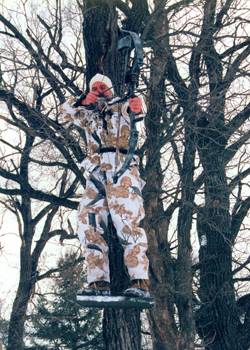 With hunters spending so much time in treestand hoping to see and get a shot at a deer, the location of the stand in relation to where they expect to see the deer is crucial. But, I often see stands hung too close to open feeding areas, too far from core areas; too far from or too close to deer travel corridors and trails; in places where the wind or thermal currents are wrong; in surroundings where the hunter is sky-lined; and often too low. In order for you to get the most out of your treestand it needs to be in the right location; an area frequented by deer at the time of the day that you intend to hunt from it. Ideally this is in a wooded or semi-wooded area where the deer feel secure in during the day.
Secure Areas
Since deer spend the majority of the daylight hours in secure areas, often in thick vegetation and wooded or low-lying areas where visibility is limited, the majority of your stand sites should be in or near those areas. If you can’t see the deer and shoot into those areas, you are too far away. Deer (especially older bucks) don’t usually leave their security areas and move into open areas until shortly before or after sunset, which means that hunters who place their stands at the edge of agricultural fields and other open areas will see fewer deer, and especially older bucks, during legal hunting hours, than hunters who place their stands in or near the secure areas.
Close Enough
A stand also needs to be close enough to where you expect to see the deer to get a shot, but far enough away so that the deer don’t detect you, either while you are waiting or getting ready for a shot. Obviously hunters using a bow, crossbow, handgun, shotgun or muzzleloader need to be closer to the deer than a rifle hunter.
When you choose a location for your stand consider the effective shooting distance of you and your weapon, and then set up several yards closer than that for good measure. Do not set your stand too close to where you expect to see the deer. Too often I see stands that are within yards of a deer trail, or are hanging off to the side of the trail where the deer may be looking directly toward the stand as it comes around a corner in the trail. If you are using a short-range weapon, and can see several yards of the trail in any one direction, you are probably too close, because the deer will probably be able to see you.
Not Too Close
Although you want to be close to the deer’s core area, where they spend most of their time during daylight hours, you don’t want to be so close that you alert the deer to your presence. You don’t want the deer to smell, hear or see you when you are in your stand; and especially when you put your stand up, which is when you can be seen, smelled or heard by the deer as you walk in, hang your stand and clear shooting lanes. How close you can get to the core area depends on the terrain, the thickness of the vegetation and the wind direction. No matter what the terrain and vegetation are like, I don’t think you can setup a stand closer than 100 yards without the deer hearing, seeing or smelling you. Air currents are often the determining factor as to where you can set up, because wind from you to the core area will carry your scent to the deer. If the wind or thermals are wrong, a half mile may be too close.
Air Currents
One of the most important considerations in treestand placement should be wind direction and the movement of thermal air currents. You want to place your stand where it is either downwind of where you expect to see deer, or down and crosswind of the direction in which you think the deer will be moving. You don’t want the deer to be able to smell you at all if possible when you are hunting, even if you don’t get a shot. If you have to set up crosswind of a deer’s approach, you should be very confident that you will be able to take the deer when it comes by, and that the deer won’t cross your downwind scent until it is well past you, which should be out of range. If a deer smells you, even if you didn’t get a shot, it may leave behind enough interdigital or metatarsal scent to alarm other deer that may come through the area. Those warning scents may linger for hours, reducing your chances of seeing any deer as long as you are there.
You also need to take into consideration the effects of thermal currents. If you hunt in country with gullies, ravines, hills or mountains, there is a good chance that changing thermal currents will not allow you to hunt some stands at particular times of the day. Thermal currents generally rise in the morning as the sun heats up the air, and fall in the evening as the air cools. When the wind is blowing these thermal currents might not be noticeable while you are hunting, and they may not affect your hunting. Thermal currents may not be noticeable even when there is no wind, but they can ruin a stand location just as easily as the wind.
When you set up your stand be aware of the terrain, and the vegetation. Thick trees (especially evergreens) in otherwise less dense areas may funnel the wind and thermal currents into some areas. If the area you hunt has changes in elevation, think about what time of day you want to hunt the area, and which way the thermals may be moving at that time of day. If you are unsure whether or not there are thermals in the area, use talcum powder, thistle down, a piece of sewing thread tied to your weapon, or a commercial to determine when and which direction the thermals are blowing.
Background Cover
When you set up your stand you don’t want to be sky-lined, you don’t want to be noticeable from a deer’s level of sight. Try to place your stand in a tree as wide as your body; or with other trees, limbs or a hill behind you. The denser the background behind you, the harder it will be for the deer to spot you. When I hang a stand I like to pick a spot on the tree, and then go to where I think I will have my shots, and squat down so that I’m at the level of the deer, then look at the spot I picked to hang my stand. If I see a lot of sky, I know I have chosen the wrong spot. It may also be beneficial to hunt with the sun behind you, rather than in your face, where and when it is possible. Having the sun behind you keeps sunlight from glaring off you and your equipment, and it makes it easier to see in front of you.
Tree Selection
There are two main things you have to consider when you hang a stand; strength of the tree and straightness of the tree. The tree needs to be big enough to support the weight of you and your stand in a high wind, and it needs to be healthy. Even if a tree is big enough to hold you it may be cracked or rotten. Check the tree carefully, to make sure there are no cracks or rotted areas in it, and give it a good thump with your tree steps or a stick to make sure it sounds solid. If you have screw-in steps you also need to make sure you can get your steps into the tree.
Height
Another consideration in stand placement is how high off the ground you want to be. Height alone can keep you out of the normal line of sight of the deer. Depending on the terrain and vegetation where you hunt, and the speed and direction of the wind or thermal currents, if you are high enough, the air currents may keep your scent above the areas you intend to hunt, and keep the deer from detecting you. On the other hand, if you are producing scents that can be detected by the deer, and there is no wind, the higher you are, the more your scent spreads out around you as it descends. One drawback to height is that the higher you are, the smaller your target zone gets, especially if you are using a short range weapon. The side of a deer or a bear offers a lot bigger target at ground level than the top of a deer or bear at 40 yards.
You should also think about the terrain around you when you choose a height for your stand. If you hunt steep hills and ravines, and the deer are moving below you, there is no need to place your stand 20 feet up in a tree, because the deer may already be 5 to 20 feet below your stand. On the other hand, if you hunt in hilly country or in a ravine or gully, and the deer move on higher ground than your tree, you may have to put your stand higher than normal, because the deer may be moving at about the same level as your stand. When you place your stand remember that one of the purposes of using a treestand is to be above the normal line of sight of the deer around you, no matter how high you are.
Shooting Lanes
While I am on the ground checking to see if my stand is sky-lined I also check to see if I have one or more clear shooting lanes from my stand. If I don’t, I decide whether or not I can cut off some limbs and brush out the area to create shooting lanes. If I have to remove too much vegetation, I look for another place to hang my stand, because cutting too many branches, and removing too much brush, will be noticeable to the deer, and they will be alert when they approach the area. If they discover a sight, scent or sound that is out of place the first time they come through the area, they may spook, take another route or travel after dark. You can avoid this by putting your stand up two weeks or more in advance, and then staying out of the area until you plan to hunt. That way the deer have a chance to get accustomed to the changes when you aren’t there, and without the sight, scent or sound of you.
Access Routes
Once I’ve hung my stands (I often hang two or three stands in the same area so I can hunt according to the air currents) I look for one or more routes I can use to get to my stand. The route I use depends on the time of day I hunt, which direction the air currents are moving, and where I expect the deer to be as I go to my stand. I like to use the easiest route I can find, a route where I don’t have to walk through a lot of brush that I might leave scent on as I walk by. I avoid rough or steep terrain if I can, so that I don’t have to work too hard to get where I’m going, which may cause me to make a lot of noise, and it may cause me to work up a sweat.
Unless I have spent a lot of time in the area, and the deer have gotten accustomed to seeing, smelling and hearing me moving through it, I try to stay well away from any deer trail, especially the lightly used buck trails and rub routes. If I have to cross a trail I try to do it far enough from where I expect the deer to be coming from, and far enough in advance of the time they get there, that much of my scent will have dispersed by the time the deer come through. If there are watercourses in the area that I can walk in, I use them to get to my stand. However, because I often scout my hunting areas every day, checking for tracks, droppings and scrapes, the deer get used to me, which allows me to walk on or next to their trails without them becoming alarmed when I hunt. I believe that if you scout your hunting area two to three times per week, between the hours of 11:00 AM and 2:00PM (when the deer are usually in their core areas) you can get the deer accustomed to your scent, and you can use the same trails the deer do when you go to your stand.
Safety
Safety should be on your mind every time you get into your treestand. But, all too often, hunters fail to use even the slightest precautions when they are in their stands. Climbing 10 to 20 feet up a tree on tree steps, and standing on a two to three foot square platform that high up is dangerous; take some precautions so that you or someone you are with doesn’t fall and get hurt. Use a climbing belt when you go up the tree, and a safety belt or harness when you are in the tree.
When my kids took up hunting I began to worry about their safety, and I realized that if they fell while they were wearing a safety belt, they might end up upside down, or with a severely injured midsection. So, I began working on a safety harness, with straps around both legs to keep the wearer from falling out of the harness, with the attachment for the tether strap between the shoulders, so they wouldn’t end up upside down if they did fall. With the tether strap between the shoulders you could also use the harness as a deer drag. Then I though about adding a couple of rings to the front of the harness, so you could use the tether strap as a climbing belt. I was well on my way to producing the safety harness/deer drag/climbing belt when I found out that there was already one on the market. I firmly believe that a safety harness is the best precaution you can take, especially if you are a heavy person, or for children.
author website: visit | author bio











 Worlds Largest Grizzly Bear
 Free Printable Targets
 Wild Animal Sound Bytes