


How To Survive In The Winter With Your Car by Gary Benton
article copyright
As the young woman drove along the isolated rural roadway she started getting concerned about the weather. Her children, ages four and six, were playing, laughing, and yelling in the back seat of the car. The weather, which had been so good when she had gone to visit her mother earlier in the day, had started turning nasty a couple of hours ago. She left her mother’s country home when the snow had started to fall heavily. As she concentrated on driving on the slippery roadway, she noticed the snowflakes were larger now and the wind had picked up. Occasionally she would have to remind the children to be quieter, so she could concentrate on the road for hazards.
Abruptly, one of the children gave a loud scream and the young woman turned to see what had happened. No sooner had she turned her head, than the rear of the car started to move to the right. Quickly turning back to watch the road, she saw a large ditch in front of the car and out of pure instinct the woman slammed on the breaks. The car, now out of control, spun in circles until it impacted the ditch, continued to turn a half a circle more, and then stopped with the front of the car nose down in the ditch.
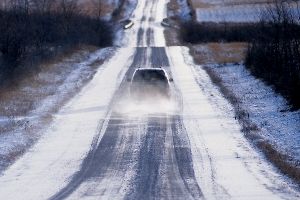 The woman must have sat there for many long minutes before she realized what had happened. She could smell the leaking radiator fluid and heard both children crying in the rear of the car. Turning her head, she noticed both children seemed safe and there were no obvious injuries. The woman noticed a copper taste in her mouth and understood she had bit her lip when the car struck the ditch. “The cold! How can I keep my babies alive in this cold? No one drives this road at night!” She silently screamed her thoughts in complete panic.
Does this story sound far fetched? Well, it isn’t, not at all. Each year motorists are stranded in cold weather on our nation’s highways and back roads. Some have small children with them and some don’t. Most, except for the most remote and unusual situations will survive. Regardless of who is in the vehicle or where you drive, there are some simple rules that all drivers should follow during the winter months.
Know the weather forecast and keep up with it at all times. I once got caught in a blizzard while driving in Alaska, and I will never forget that experience.
Tell someone when you are leaving, where you are going, who is going with you, when you expect to return, and what you expect to do. For instance, I am leaving in the morning with little jimmy and we will be back on Wednesday. We will stop at the amusement park on Wednesday morning.
If the weather suddenly turns severe find a place to stop or do not start your trip. Make sure as soon as possible you notify those who expect you to be at a given point at a given time. If you don’t, they may contact the police and a search and rescue mission could be started…for you.
If you must go out in bad weather, dress properly for it. Many people do not wear boots, coats, or gloves, thinking they will be warm in the car. Then, once the car is stalled, serious problems result. Always dress for the most severe weather you could encounter.
Stay on the main roads if you have a choice. The main road contains higher traffic, the police will cruise this roadway during bad weather, and the snow removal teams will clean the main roads first.
During the winter months carry a survival kit in the trunk of your car. Keep wool blankets or sleeping bags in the car as well. Some folks have even added a small lightweight tent.
Always, at all times, carry a commercial first aid kit in your car.
If your car stops or becomes stuck, do not run the engine to keep warm. Each year people die from carbon monoxide poisoning doing just that. It is safe to run your engine to keep warm only as long as your muffler is not coved with snow, blocked, and you keep two windows open to allow fresh air in. I suggest you never use the engine to keep warm because it is just too dangerous to do, snow may block the muffler or you may have an exhaust leak and you won’t know.
Tie an orange strip or triangle of material to your antenna. I carry one that is used on bicycles and it would work just fine. Some car survival kits have these small orange flags. My cousin has one made from an orange garbage bag.
If you leave the car to seek shelter, do not go too far. Rescuers will look in the area of your vehicle for you and falling snow could easily cover your tracks.
Shelters out of the car should be in a wooded or rocky area, if possible, because trees will assist in blocking the wind. Use a tarp, blanket, or whatever material you have on hand to make a simple lean-too shelter. Do not clean falling snow off of the shelter, it will help insulate it, unless it starts to bow in from the weight. Do not make your shelter under dead tree limbs, because they could fall during high winds.
If you can, use the natural surroundings for shelter construction. You can usually find a “pit” free of snow under large cedar or pine trees after a heavy snowfall. Or, you can place logs or limbs up against a fallen log or rock to back a natural shelter. Do not use a stalled vehicle as a shelter, because it is made of metal and will become very cold.
Make sure your fire is made in a safe area, with no low limbs that could catch fire. If there is a lot of snow, you may have to lay a platform of green logs to make your fire on, fires made on deep snow will burn, melt the snow, and then put themselves out. The logs will eventually burn through, so be prepared for that event. Also, keep your fire small. You can use rocks or stacked logs to reflect the heat from your fire, by making sure the reflector is180 degrees from the entrance of your shelter with the fire in the middle.
Once you are organized, do not leave. Stay where you are until help arrives. If you leave the spot, rescuers may have to spend addition time, which could prove fatal for you, looking for you, the weather may get worse, or you may suffer from hypothermia.
One aspect of winter survival most people never consider is dehydration. In cold climates we tend to drink less than normal. If your urine is dark in color increase your water intake. Do not eat snow or suck on ice, they will lower your body temperature. Instead, melt them in a container first if possible.
Hypothermia is the lowering of the body’s core temperature and it can be fatal. Once you have a shelter constructed and a fire going stay where you are and keep warm, as well as dry.
While surviving in the winter can be very difficult, it can be done. Just because your vehicle breaks down, or you become stuck, is in some ways no different than encountering a survival situation while hiking. Survival is survival, though there are obviously different challenges in each situation. The key to your survival is to think before you act, stay where you are once you’re organized, prepare by having the right equipment with you, and gain the knowledge you need to survive before you need it.
As I suggested above, some survival items I always have in my car in addition to my basic survival kit are, a two liter bottle of water, a poncho, and a signal mirror. I suggest you consider carrying them as well. Each driver can add additional items and eventually develop a large kit, but remember you do not want to fill up your trunk. In addition, try to select items that serve more than one purpose.
Also, if you are inexperienced with survival, purchase a survival manual to go along with you. At least make sure your car survival kit at least has the following items packed in it:
A quality penknife or jack knife.
Large zip lock freezer bags or latex gloves for water storage.
Waterproof matches and a lighter.
Flint and steel or a metal match.
Water purification tablets.
A long strip of heavy-duty aluminum foil folded up to cook with.
Fishing kit, i.e., hooks, sinkers, and some line. Nothing fancy.
Commercial first aid kit or with instructions, I also place a small hotel size bar of soap inside mine.
One small pack of gum and one pack of hard candy for quick energy.
Casualty Blanket, sometimes called a thermal blanket.
Wool blankets or sleeping bags.
Instant powder broth, beef or chicken, four servings total.
Survival Whistle, small, made of plastic and with a lanyard.
A flashlight.
Approximately 50 feet of nylon cord.
author website: visit | author bio











 Worlds Largest Grizzly Bear
 Free Printable Targets
 Wild Animal Sound Bytes