


5 Factors For More Ruffed Grouse by James L. Bruner
article copyright
It happens quickly as a thunderous ruckus invades the eardrums doubling your heartbeat while eyeballs search frantically for the source. The flush of a lone ruffed grouse fades quickly from sight dodging trees at a speed of more than 20 mph. Senses heightened your next step flushes another bird that offers a decent shot and in mere seconds your first grouse of the season is on the ground. With the sound of the shot still ringing in your ears, a few feathers floating to the ground, and the crisp autumn air accented with gunpowder, you claim your bird and create another outdoor memory.
Scenes like this unfold every year as the grouse hunter takes to the woods but more often than not you will probably be coming home empty-handed. And, to be perfectly honest I hunt in the Upper Peninsula of Michigan. The state of Michigan continually ranks in the top three states for ruffed grouse hunting so maybe my experiences would be a bit generous by average standards. I firmly believe that my advancement into hunting was grown from those first days of grouse hunting many years ago and remains a great introduction to today’s young hunters. But, regardless of the experience or area where you hunt there are some basic steps you can follow to improve your percentages at scoring on more ruffed grouse this year.
Know Where Not To Hunt:
1. Habitat is obviously essential but many people fail to recognize decent habitat that allows the grouse to flourish and sustain population numbers. Keep in mind that grouse are as much a prey item for other winged birds as they are from your typical ground predators. Hawks, owls, eagles, and falcons can have a significant impact or grouse as they swoop from the sky for an easy dinner. That in mind grouse understand that the less time they spend in open areas and areas of minimal canopy cover the better their chances of survival. Grouse will venture into somewhat open areas such as road-sides but their time spent there will be very limited. Don’t waster your time hunting areas so open you can see hundreds of yards at a time.
Habitat To Look For:
2. Habitats that often holds grouse are considered border or transitional areas. What is meant here is look for places that contain two different types of forest and/or terrain. Old growth forest that meets new growth forest is especially appealing to grouse. Take an old growth cedar swamp that borders with an area that was cut years before and has grown back as young aspen (poplar or popple) trees. Areas of transition such as these offer the grouse the opportunity to seek out insects and fresh shoots of legumes in the more open area of the aspen while still providing adequate nearby cover should a threat occur.
Ruffed Grouse Fall Food Sources:
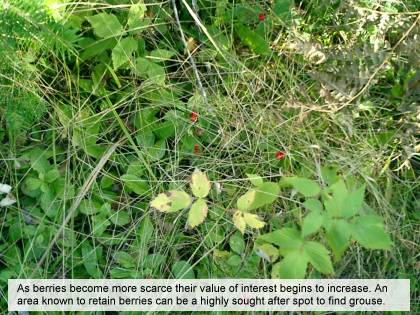
3. Concentrating on food sources for the grouse can be difficult since it utilizes numerous food items but in the fall you can concentrate more on berries. It’s likely you have probably come across berries in the past and probably more than likely you paid them little attention. Now is the time to pay those berries some attention and a visit. In the past some of my own best hunting has been where the berries were most prolific and found well off the beaten path. A berry patch I found while scouting for an upcoming archery deer season proved to be one of the very best places to score on ruffed grouse until the area was clear-cut several years later. Berries that are still hanging on mid to late September or early October are prime food sources if adequate cover is available. Even in instances where cover seems scarce I would still check out patches of berries thoroughly. I’ve seen birds fly through rows of Jack Pine plantations and right into a small area that held lots of berries. The birds often spent the entire day here unless they were pushed from their dinner table.
Water Can Be The Connecting Point:
4. Water is not considered an essential when seeking prime grouse hunting as they can extract the necessary liquid from the foods they eat. However, water can be the key the growing those foods that the grouse prefer such as berries. The edges of water have always been particularly of interest when I venture out for a day of grouse hunting. Many people say that ruffed grouse, partridge as we choose to call them, will not form coveys but may hold very small family groups at different periods of the year. Some of my most productive grouse hunting has been along the shores of a bay or lake walking just inside of the trees where we flushed coveys of birds, sometimes as many as 20, in a single small area. I won’t argue with the experts about coveys but a group of birds that large would certainly be a big family group. And this has same scenario has repeated itself in numerous areas practically all very near to large water sources. Water also provides a larger source of insects which is another menu item that the partridge will eat when possible.
Slow And Easy:
5. There are probably some grouse hunters out there reading this wondering why on earth the use of trained dogs hasn’t been mentioned. There’s a single good reason. I have never hunted grouse with dogs. Plain and simple. I believe it’s important to speak of which you know or have experienced rather than try to play a role for the sake of an article. However. I have put on many miles on the boots and can tell you that wandering through the woods like it’s just another day picking morels is probably going to make you wish you were looking for morels rather than partridge which ultimately sounds like one hell of a good meal.
When hunting grouse without the aid of a dog you will find yourself in a slow hunting mode. Think more like stalking your game at a slow but progressive pace. If you’re in grouse country you’re likely to flush a bird or two before you understand that you’re probably moving too fast or not anticipating the flush. Adapting has a relatively short learning curve when speaking in terms of your pace but training your eye to pick a grouse out of the woods can be challenging. Often you will catch the bird shifting or moving slightly before it bursts to the sky. For those grouse that hold tight you’re likely to notice the shape of the grouse’s head before realizing the entire outline or body mass of the bird. One thing you will realize is the need to scan the area back and forth liberally like radar searching for a new signal. Pay particular attention to those spots that have similar qualities to places where you have taken birds in the past. The recipe for success often repeats itself.
During my walks I try to avoid a lot of walking and stopping as this motion tends to put the animal on alert and trigger the panic and flight response. Again a good slow walk will typically work best. Keep your ears trained also as often you can hear a partridge running through the leaves. And I do mean running. Before the bird begins to run it may begin a low peeping sound which is a dead giveaway that a very nervous bird is nearby. A partridge strutting like a chicken is also a sign that the bird is likely to take to the air. You’re not waiting for that perfect broadside shot here so, unless you prefer shots at flying birds, it’s time to shoot.
And it’s time for me to head out for a quick walk this evening to get a flush count from the property. After limited hunting in this immediate area and some minimal changes in land structure the grouse right out the backdoor are growing in numbers. Now that’s great news to my ears!











 Worlds Largest Grizzly Bear
 Free Printable Targets
 Wild Animal Sound Bytes
Hey to the author I’m a yooper also and have been partridge hunting for 20 years. it’s one of my favorite hunting seasons. I dont use the dogs either. Good article i enjoyed. Thanx
Thanks for a very good article.
My grouse hunting now is a side benefit of bow hunting for Deer, Moose and Elk. I cary a Flu Flu with a 2 blade broadhead for the chance meeting with a partridge.
When I was growing up we had good bird dogs, and later on I had a great Black Lab that was a joy to hunt Ruffies with. I miss the game now and often think about the great days shooting Ruffies over a well trained flushing dog that would put birds across the old trails in front of me.
Pete