

The new year brings that time of season when many hardwater anglers find themselves dealing with marginal ice conditions. The anticipation of a fresh bucket of fish is often the persuasion that leads to serious problems as anglers venture further onto the ice encountering unsafe conditions. Knowing where you’re going, hazards that may arise, and leaving specifics with family or friends, can mean the difference between an enjoyable day in the outdoors and serious risk.
Growing up in an area that was renowned for it’s icefishing brought many anglers from miles away to try their luck. It also brought an onslaught of regionally uneducated fishermen who often walked a fine line across a watery grave without even realizing the situation. With that very harsh statement of truth let’s take a look at safety and ice conditions as well as the factors that can make stable ice and ice travel unsafe. If you’re expecting a sweet little lecture on the subject then throw away those expectations. I’ve seen vehicles, teams of sled dogs, snowmobiles, atv’s, and people walking on foot fall through the ice. Some of them never made it back to the surface.
First of all ice conditions aren’t your only element to consider. Weather, more directly, snow, plays a large role in safety. When you’re fishing a mile from the shoreline it’s easy enough to pinpoint visual targets that act as beacons on your return after a day of fishing. Throw in a sudden snowstorm and you’ve just lost your direction. Toss in a bit of wind and now you’re staring down the barrel of a whiteout where you have zero reference of visual travel. Best advice in this situation is to stay put. I’ve spent more than a couple evenings in a fish shanty or portable shelter until a snowstorm has cleared. If you’ve followed the basic guidelines of letting someone know where you were headed they should also have the reassurance that you will stay put if a storm suddenly rears it’s ugly head. Of course the majority of this encounter could have probably been avoided by checking your local weather.
Here’s a few tips for waiting out a storm or making your way to the shore after getting caught in a snowstorm.
1. Always carry a compass. A lot of people laugh at the idea of these seemingly ancient devices but this inexpensive, easily carried item, can send you in the right direction if your GPS fails due to battery loss.
2. Take a compass reading from the shoreline. More specifically a reading from your launch area would be best suited. You can synch this with your GPS to ensure proper readings are reported and make any calibrations before heading onto the ice.
3. As already mentioned staying put in your shanty or portable fishing device is your best option when visibility has been severely reduced. This offers shelter from the cold and wind, and, while you’re sitting there, keep your fishing lines in the water.
4. Don’t leave your point of shelter at the first sign of a storm beginning to let up. Often there will be snow bands that follow which could strand you during your travel. Consider the time it will take to reach the shoreline and leave additional time for traveling through the new snow.
5. When finding yourself out in the open during a snowstorm on the ice it’s time to break out the compass and, or, GPS. Also pay attention to wind direction. Often, in this area, our sustained winds come from the north or northwest. Having this little bit of information can help guide you along but should only be used as a reference as a last or only resort.
Ice Conditions
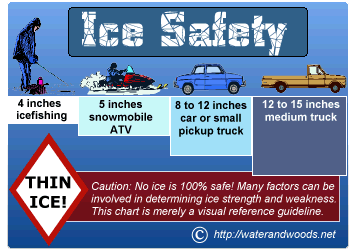 Many factors are involved in determining the strength and weakness of any ice formations. The flow of water beneath the ice, the previous and current weather, structural protrusions from the ice surface, snowfall and previous snowfall, as well as daily travel from people all factor into the equation. These elements are more significantly noted later in the season as early ice will show these hazard areas profoundly before cold weather really sets in for the season. Note areas that have open water when the rest of the lake or pond is frozen over. This typically reveals a current beneath the surface which keeps the water moving and consequently creates a hazardous area that could lead well into the season. Common areas to observe these conditions would be most prominent at the mouth of a river or creek as it meanders into the larger body of water. Other areas such as rocky points with sloping banks can also create the same effect and should be avoided. Similar scenarios involve a large body of water flowing into a larger body, such as an inland bay opening into a large lake. Point in reason back to my old icefishing grounds where the bay tapers down before entering a larger portion of the bay and then into Lake Michigan. A very well known rocky point with a steep drop-off helps create enough current to make that portion of the bay unsafe all year round. Even when the rest of the bay looks like a small city of bustling fishermen this area is hazardous and has claimed numerous lives.
In general terms there are some visual cues to the possibility that you are entering poor or unsafe ice.
Slushy areas on the ice note the obvious presence of water. While this doesn’t always mean the ice is unsafe you should proceed with caution and avoid such spots if possible. Ice that looks crusty or honeycomb is fairly typical throughout the season and is evidence that the ice is beginning to deteriorate. This can be caused by rising temperatures and the re-freezing that takes place afterward when temperatures drop once again. Other than the obvious notation of open water, honeycomb ice should be regarded as unsafe and avoided as it’s difficult to gauge how much of the actual ice has been degraded. Clear ice is your strongest. Without the presence of snow it can be hard to discern where the ice might end and open water begins but the clear ice provides the best support.
Formations on the ice such as pressure cracks, pressure ridges, or ice-buckling are common on larger bodies of water. Some fishermen will see this later in the season where two masses of ice have pushed up against one another, typically in an area of underlying current or structure, and create a wedge or teepee like formation. These formations can be miles long and often fishermen will need to find a new route to their fishing spot when driving on the bay with a vehicle. This creates a single area where most fishermen will drive their trucks across day after day. It’s not uncommon to see open water in between these ice formations as they continue to push against one another forcing them to grow in height. Regardless of the formation or structure, this scenario signals a weak point in the ice with typically deeper water and current below. As is the case it’s nearly impossible to avoid these pressure cracks for fishermen and they must be dealt with. Extreme caution is the best advice here if you absolutely need to travel these areas.
Islands, sunken pilings, docks, reeds, and even weeds can play a part in the makeup of ice strength. In each scenario these element reach the surface, extend above the surface, or lie just beneath the surface of the water. During times of ice formation these structures and elements become part of the ice and it goes without saying, substantially weaken the ice. A basic rule of thumb is to avoid or use extreme caution when approaching anything that protrudes from the ice with the exception of very shallow water where the ice will freeze all the way to the bottom.
Now that we’ve steered you away from the danger and you’ve still fallen through the ice, what can you do? Well, it’s unfortunate that accidents do happen and we simply cannot foresee all dangerous things in life so here’s some tips for that scenario of falling through the ice.
First, if it’s an extreme constant concern or perhaps a phobia, then wear a floatation device. I can’t imagine that the actual event of falling through the ice is as boding as looking up from underneath the ice for most people. I’ve been there. Yeah. Now the author tells us he’s fallen through the ice! You learn from your mistakes and in this case the learning curve is very steep with two options. You either make it or you don’t. It’s really that simple. So as I mentioned if the probability of falling through the ice is ever present in your mind then perhaps the ice isn’t safe to begin with. In either event a personal floatation device may be the safeguard that rings true on the top of your list but here’s another very simple device that can help you.
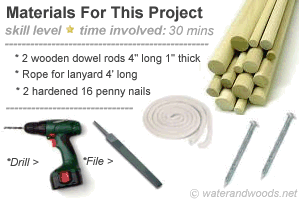 You can build your own ice picks which can be worn around your neck to help pull yourself from the water back onto the slippery ice. This can be built for practically nothing in 30 minutes with relatively no experience required. See material list graphic for your raw materials and tools needed.
1. Cut two lengths of 1″ thick wooden dowel rod into 4 inch sections.
2. Drive your 16 penny nail into the center of each dowel rod until there is about an inch of the nail left sticking out. File off the nail head and sharpen this same area to a point with your file.
3. Drill a hole through each dowel rod on the opposite end where you drove the nails into the dowel. About a half inch from the end will do just fine.
4. Cut your rope to roughly 4 feet and slide through each hole in the dowels you have just drilled. Fasten the rope by tying several knots in the end so it can’t slip back through the hole in the dowel and you’re done. Now you can hang this ice pick around your neck when you venture onto the ice.
How To Use The Picks
If you’ve fallen through the ice the first thing you really need to do is stay calm. Understandably that’s a tall order considering the circumstances but it is imperative. Your clothing will help you stay afloat due to the air trapped inside the garment. Turn your body back the way you came from when you fell through the ice. This will be the safest route. Work your elbows onto the ice and grab your ice pick from around your neck. With a pick in each hand drive them into the slippery ice in succession to help pull yourself from the water. Kick your feet in a swimming motion to help propel yourself further onto the ice. Once you’ve managed to pull yourself from the water do not stand and run away from the hole. Lay on your side to disperse your weight more evenly and roll in a direction opposite of the open water until you’re safely out of danger. You’re glad you took the time to make these little ice picks aren’t you?
Now. This is all fine and dandy but what should I do if my vehicle falls through the ice? With me in it!
The latter part of the previous method for falling through the ice would also come into play here. There are also some suggestions that have changed in recent years and of course some obvious thought to your own abilities. All in all they all require getting out of the vehicle as quickly as possible. Years ago it was always suggested that the person let the vehicle settle before trying to escape. Personally, I’m out of there. I wouldn’t sit on a sinking ship and wait for it to settle to the bottom so why would I entail that procedure in a truck?
The fact of the matter is a vehicle will often plunge down nose first because of the engine weight. Don’t expect the truck, or car, to slide down in one fell swoop. It’s unlikely that would happen in the majority of cases. This is where your time to escape comes into play and with a few tips you can cut that critical time down a bit with a few suggestions.
1. Remove your seat belt before driving out onto the frozen water. There’s no need to be fumbling around with a seat belt when the ship is sinking.
2. Roll down your window a bit, or, if preferred, all the way. More than likely the window will be your escape route especially if the vehicle hangs-up on the ice and the door are jammed shut.
3. This isn’t a method I subscribe to but I do know many people who will drive with their door cracked open. The belief is if the vehicle does start to fall through, the open door could act as a wing and stabilize the vehicle on top of the ice rather than falling through all the way. I can attest to the fact that quite often the ride out to your fishing area is quite bumpy and sometimes extremely rough. I wouldn’t want to be sitting there trying to hold a door open with no seat belt on as you would likely end up face first in a pile of snow along the way. But, to each his own.
All in all this article isn’t intended to deter anyone from icefishing. The sport itself, like so many others, does carry a certain inherent amount of risk but the challenges and rewards are the allure to millions of fishermen year after year. With a little common sense and an understanding of the possible pitfalls you can make this season of icefishing productive and safe.











 Worlds Largest Grizzly Bear
 Free Printable Targets
 Wild Animal Sound Bytes